
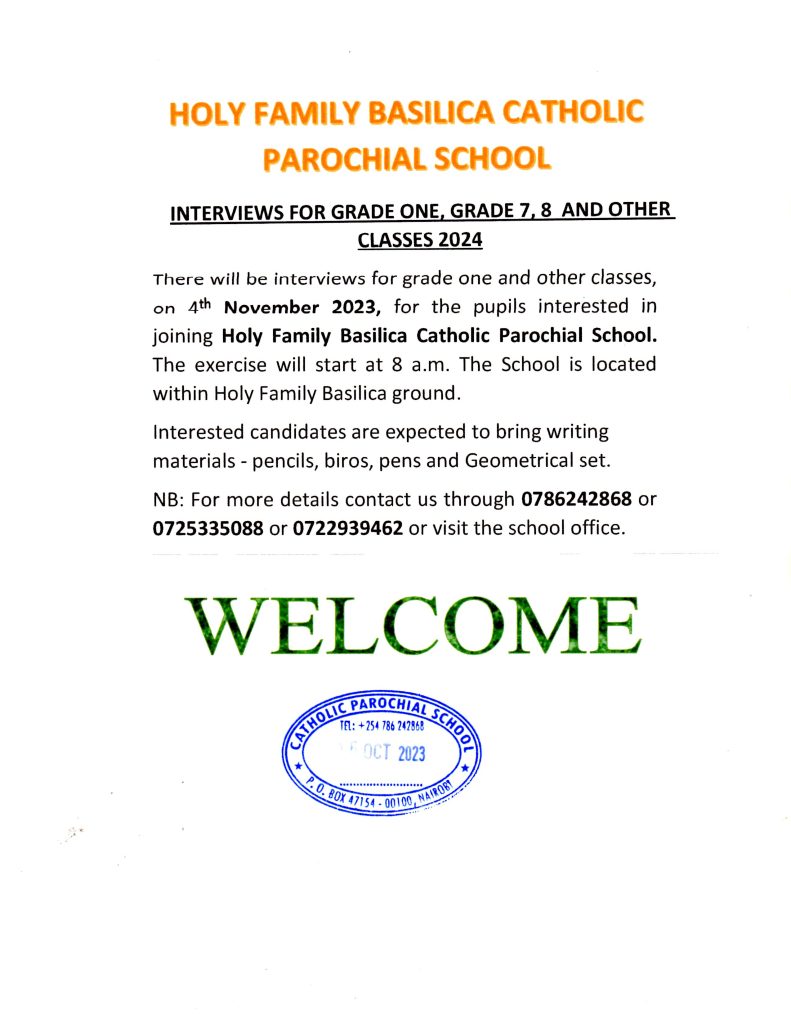
Interview for grade 1 to grade 8
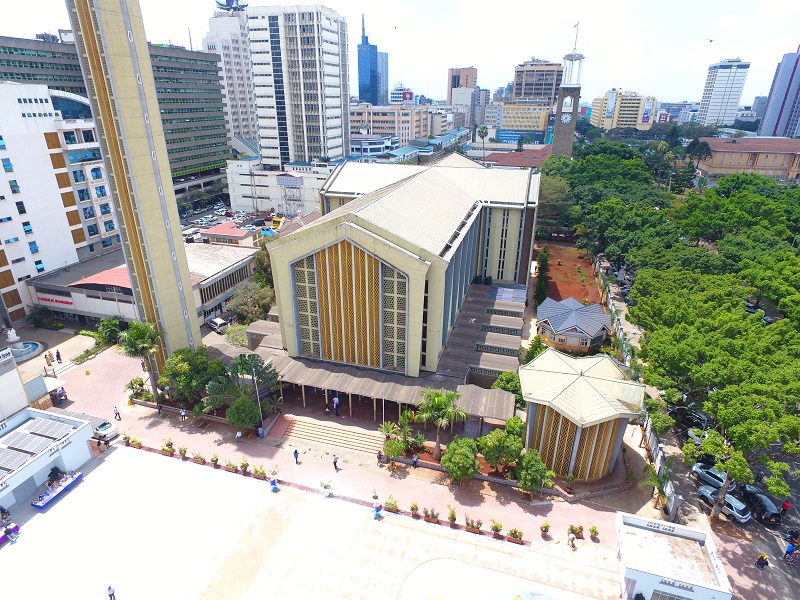
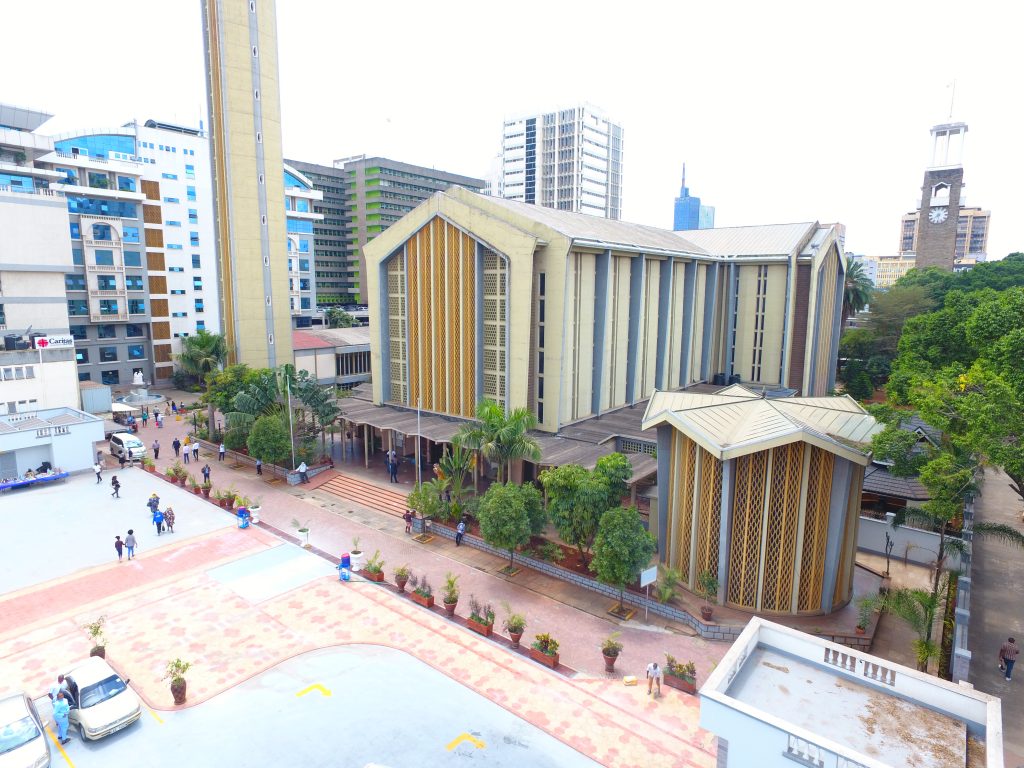
Established: 1904
Establishing congregation: Holy Ghost Fathers
First Administrator: Brother Josaphat, C.S.S.P (Holy Ghost Missionary)
Current Administrator: Rev. Fr. Peter Kamau Kamomoe (Diocesan Priest)
First Archbishop: His Grace John Joseph (J.J) McCarthy, C.S.S. P- (1953-1971)
Current Archbishop: His Grace Philip Arnold Subira Anyolo (Appointed 28 Oct 2021, Installed 20 November 2021-to date)
Location of the first stone church structure within the compound: near the corner next to City Hall Way-Parliament Road junction (built in 1904)
First PPC chairman-Gatimu, father to Rev. Fr. Kinuthia who was the first black/African Priest to be posted to Basilica
- The first baptism: Sunday 13 January 1907 (Janvalio Pinto Cyrillo)
- The first marriage: Monday 1 June 1908 (Joannis Mattery and Margarittam Cheresary)
- First confirmation: 1923
Mass attendance: In 1960, there were seven masses every Sunday
Today;
- Monday to Saturday: 2000-3500 Christians
- Sunday: 4000-10,000 Christians
When was it designated a Basilica: 15 February 1982
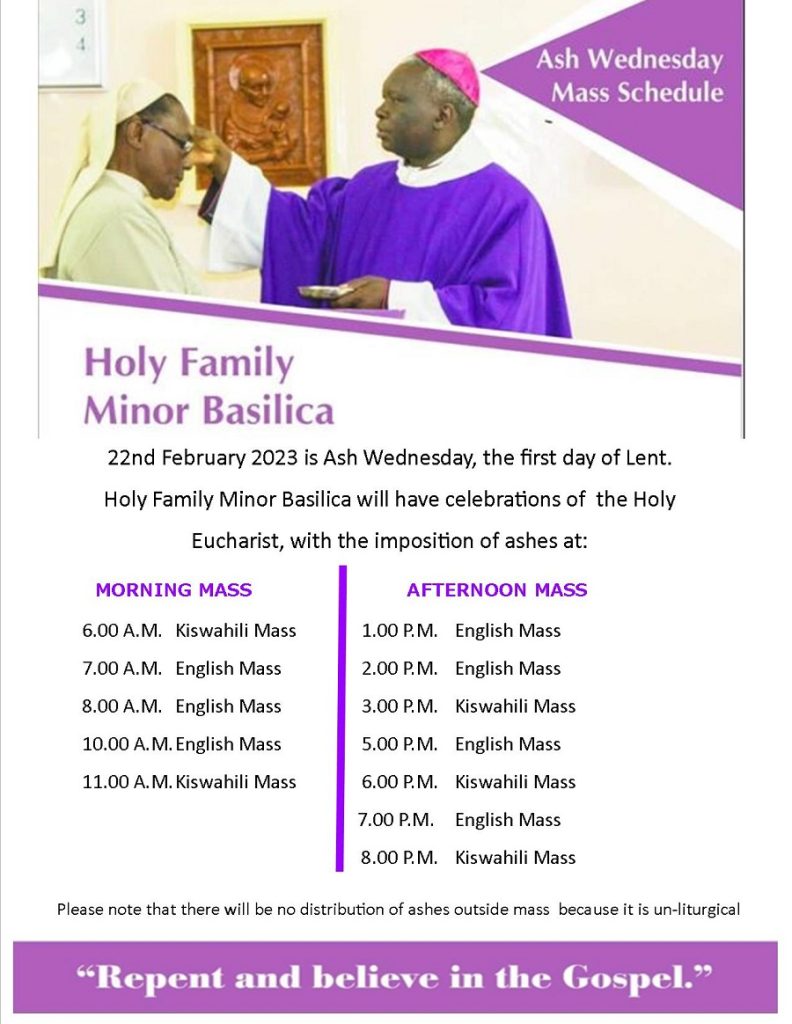
| MASS SCHEDULE | |
| Monday – Friday | 6.30am, 7.15am, 1.15pm & 5.15pm |
| Saturday | 7.15am, 12.30pm & 6.00pm (Vigil) |
| Sunday | 7.00am-Kiswahili mass 8.00am-English mass 9.30am-Kiswahili mass 11.30am-English mass 5.30pm-English mass |
| Mass for PMC 10.00am | |
| Public Holidays | 9.00am |
| CONFESION SCHEDULE | |
| Monday – Thursday | 4.00pm – 5.15pm |
| Friday | 6.00am – 8.00am, 12.00pm – 1.00pm & 4.00pm – 5.15pm |
| Saturday | 10.00am – 12.30pm & 4.00 pm – 6.00pm |
| Sunday | 7.00am-2.00pm |
| OFFICE HOURS | |
| Monday – Friday | 8.00am – 4.00pm |
| CLOSED ON WEEKENDS & PUBLIC HOLIDAYS |
Mary Mother of the Church
“Hail Mary full of Grace the Lord is with you blessed are you among women and blessed is the fruit of your womb Jesus… Holy Mary mother of God pray for us sinners now and at the hour of our death Amen”
Behold, I am the handmaid of the Lord. May it be done to me according to your word (Lk 1:38).
When Mary uttered these words, she opened herself to participate in the redemptive work for humanity. The Fathers of Vatican II Council taught: The motherhood of Mary in the order of grace continues uninterruptedly from the consent which she loyally gave at the Annunciation and which she sustained without wavering beneath the cross, until the eternal fulfillment of all the elect. Taken up to heaven, she did not lay aside this saving office but, by her manifold intercession continues to bring us the gifts of eternal salvation. https://ofm.org/blog/marys-intercession/By her maternal charity, she cares for the brethren of her Son, who still journey on earth surrounded by dangers and difficulties, until they are led into their blessed home (Dogmatic Constitution on the Church, 62)
By accepting her Son’s testament of love, she became the Mother of the Church and welcomed all people, as sons and daughters, to be reborn into eternal life in the person of the beloved disciple at the Foot of the cross (cf. Jn 19:25). By giving her mother to the beloved disciple, we also became her sons and daughters. In the New Testament, Mary’s cooperation with God is progressive. It started with the conception and birth of Jesus, thus beginning the redemption work (Lk1:38; Lk 2:7); interceding with him at the wedding of Cana of Galilee (Jn 2:3); attending to Jesus at the cross (Jn 19:25) and her presence at the founding of the Church in the Upper Room during Pentecost (Acts 1:14). She persists with her role as our Mother in heaven even today (Rev 12:17). She is continually telling us to do whatever her son Jesus tells us by obeying His word and Church teachings.
“As Mariners are guided into the port by the Shining of a Star, so Christians are guided to Heaven by Mary” –St. Thomas Aquinas
She was declared the mother of the Church; mother of the entire people who call her most loving Mother on 21st November 1964 during the Vatican II Council (cf. incarnation, passion, Pentecost, and assumption). On 11th February 2018, the memorial of the Blessed Virgin Mary of Lourdes, Pope Francis declared this votive celebration in honor of Mary to be a feast for the Universal Church.
The Memorial of Mary under the title, Mary Mother of the Church (Mother of all Christian People) is to be celebrated annually on the Monday after the Pentecost. This will help to promote devotion to our Mother Mary who is the Mother of the Church. Pope Francis says, “The Blessed Mother Mary is not just the Mother of Jesus but the Mother of the Church”. She is an important figure in the life of Christ because everything about her points to Christ.
The more we are united with Mary, the more we are united with Christ because she participated actively in the physical and spiritual life of Jesus. Therefore, seeking Jesus through Mary does not take away the glory from God, but rather gives Him great glory. In one of his writings; St. Augustine says, “Mary is the mother of the members of Christ because with the charity she cooperated in the rebirth of the faithful into the Church.” On the same note St. Leo the Great said, “The birth of the Head is also the birth of the body.” Both the saints indicate that Mary is at once Mother of Christ, the Son of God, and the mother of the members of His Mystical Body, which is the Church. Therefore, we have all the reasons to have recourse to her.
The mother of God is not just someone from history; she is still our Mother today and is always praying, supporting, and leading us closer to her Son Jesus Christ. She is always attentive to our physical and spiritual needs. Pope Pius XII saw Mary, not as an abstract of the study, but a living person, highly favored by God and powerfully intervening in our lives. She continues to give us the son she brought into the world and to gather the whole family of Christ around the mystic Bread, a symbol of unity, peace, and eternal joy of heaven. He went further to say that; to love Mary is to love the Church and to love the Church is to love Mary. She is the Centre of unity in the divided Christian Family. Her motherly influence is capable of remedying the world’s ills, freeing it from its anguish, and leading it towards the way of salvation. She is the cause of our joy since the sorrow brought into the world by Eve’s disobedience has been changed into joy by Mary’s obedience. Wherever she is there is joy (cf. visitation).
Mary our Intercessor
We invoke in the Church the Blessed Virgin under the titles of Advocate, Helper, Benefactress, and Mediatrix. However, this does not take or add anything to the dignity and efficacy of Christ as the one mediator. St. Paul says that there is one and the only mediator who is Christ Jesus who gave himself a ransom for all (cf. 1 Tim 2: 5-6). However, speaking of the maternal mediation of Mary, it does not diminish or contradict Jesus’ mediation. The maternal role of Mary towards men never obscures nor diminishes this unique mediation of Christ, but rather shows its virtue (LG 60). We do not pray to Mary but we ask for her prayers. We pray only to God; whereas we invoke or call upon His mother. Our requests for her intercession do not diminish our devotion to Christ but rather enriches it. She does not obscure her son. When we admire her gifts and praise them, we admire and praise the divinity, goodness, and power of Christ.
The Blessed Virgin is the greatest pattern of prayer especially intercessory. She is the pattern and special intercessor for those who, amid temptation, strive to preserve their identity as children of God. She surrounds any devotees of her with motherly care, enlightens them with her wisdom, and comforts them with her love. She shines forth as a sure hope and solace for the pilgrim People of God (LG8). She is a member of the Church, but a unique member. No real devotee of hers has ever been lost. None who has ever sought her help was left unaided. That is why Blessed Joseph Allamano said: “He who Catholic Faith wants to reach sanctity without Our Lady wants to fly without wings”. Without her intercession, you can do nothing.
St. Thomas Aquinas said, “As Mariners are guided into port by the Shining of a Star, so Christians are guided to Heaven by Mary”. She who was taken to heaven, body, and soul, the Mother of the Church, is working hard for us, her children, to join her in heaven. She is our dear mother who loves us as the apple of her eye. With the confidence of loving sons and daughters, she wants us to have recourse to her while trying to listen to her commands and desires. The latter is concerned with our duty to become good and holy. The title; “The Blessed Virgin Mary, Help of Christians”; has been given to Mary since 1814 24th May by Pope Pius VII to celebrate her extraordinary intervention in the life of Christians during the persecution in the hands of enemies. Therefore, in our journey of faith, we dare to battle with the devil since we have a mother who accompanies and intercedes for us.
Mary is a woman who is attentive and ready to help when the situation seems bad. She is able with a glance to see our needs and act immediately with ease. It portrays a quality of caring mother who is perfectly available in absolute faith. She understands the message of the angel at the Annunciation “nothing is impossible with God” (Luke 1, 37). We explicitly see her mediation at the wedding of Cana, where she and Jesus were invited. Through her intervention in breach of wine, Jesus anticipated his future time in the sign that it operates (cf. Jn 2:1ff; 1Tim 2).
In this event at Cana, Mary appears as a collaborator in the history of salvation. By inviting the servants to do what Jesus tells them; Mary becomes the first to engage others to become the new people of God. Here she is already putting in a sense her spiritual motherhood. Just as Moses at Sinai was the mediator of the covenant between Yahweh and Israel; Mary according to the account of Cana, has a mediating role in the realization of the alliance between Jesus and those who serve. Her mediation, therefore, has an intercessory character where she intercedes for humanity.
Our Mother is the seat of wisdom; incomparable wisdom and prudence in the things of God. She is the wise virgin who chose the better part thus became a teacher of truth who hands on to her children the saving deeds and words of her son, which she treasured in her heart (Lk 2:19, 51). She is a model of all virtues. Humanity is striving to attain these virtues, and conquer sin to grow in holiness by raising eyes to Mary who shines as the exemplar of virtues for the whole company of the elect (LG 65). She is the model of worship in spirit.
She is a virgin unsurpassed in the purity of faith whom the Church always strives to imitate. Mary is the mother of good counsel since she is the mother of Christ whom Isaiah in his vision called a wonderful counselor (Is. 9:5). As the pillar of faith, she supports and protects the faith of her children through prayer. She teaches us how to endure in faith as she did following Jesus and standing at the foot of the cross, enduring his death believing that all will be fine. As a mother, she supports the faith of her children from heaven through her intercession pointing to us the way of truth. Mary Our Mother and Mother of the Church, Pray for us your children. AMEN.
*** By Fr. Evans Mochama Mogwanchi ***
The writer is a Consolata Missionary
Excerpt from the Basilican Magazine, 2018 issue
– By Rev. Fr. Peter Kamomoe- 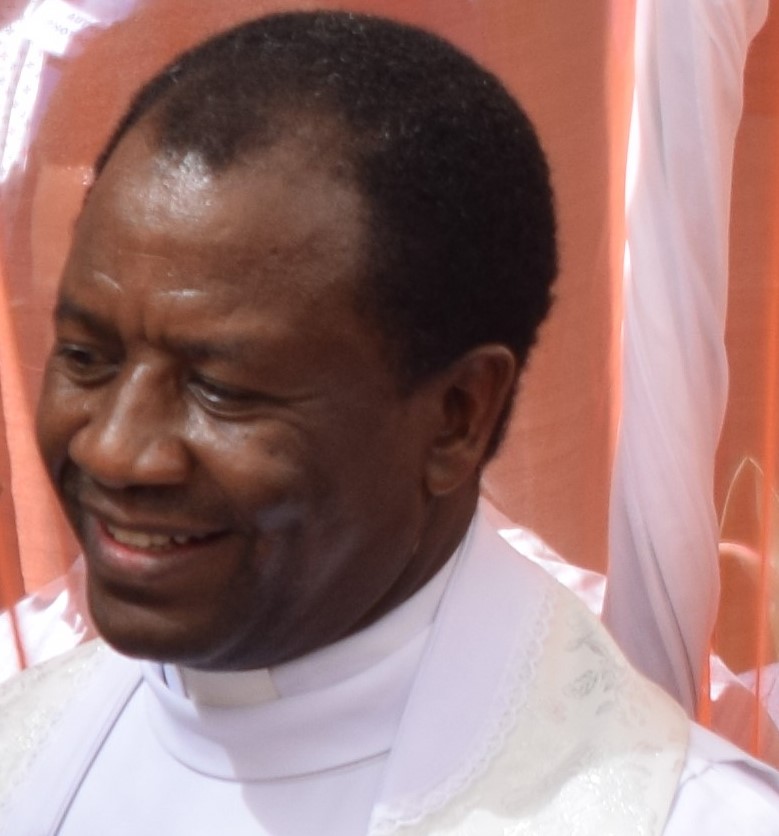
Morals and morality are familiar words in our daily talk. Morals as the acceptable ways of behaving; good, right, proper or acceptable.
Morality on the hand, more so, according to St. Paul is the work of something natural in man possibly the expression of innate knowledge of right and wrong. This is evident in his address to the people of Corinth. It involves notions such as rightness and wrongness, guilt and shame; the voluntary action that does not necessarily depend on factors external to the person, but on the person himself. We can conclude that morality is the moral institution of humanity.
Any individual brought up naturally with well-defined social instincts would inevitably acquire a moral sense. Ironically, some of whom are believed to have grown up in the normal and most natural and social paths portray the contrary behavior because natural ways are not enough without God’s graces and Spirit.
Today’s society is full of corruption and the society ignorantly tolerating and validating it, citizens deliberately electing leaders who are obviously known to be immoral and corrupt, spouses who cheat on their partners, domestic violence, spouses killing their partners so that they can take charge of the family wealth, children lying to their parents about their illegal activities, doctors selling patients’ drugs, teachers helping learners cheat in examination, engineers approving substandard buildings because of bribes, managers and administrators using their positions to manipulate the decisions of the institutions, lecturers exchanging grades for sex, companies polluting the environment, business owners deliberately not disclosing or submitting the correct taxes, employers mistreating their employees, politicians embezzling public funds. These are a few examples among many that you have been a perpetrator or a victim of.
But the big and common question is, as a Christian, are you convinced that people need to be morally upright? Has your faith influenced your morality? Have you resolved to pursue good in life and avoid evil which is a basic moral principle for all Christians and the people of God?
Surely, there is the erosion of moral frameworks in ‘modern’ society. And this, in my mind, seemed to raise the question of “why?”
Borrowing from Kohlberg’s theory (1958) on moral development, it is essential for parents, caregivers, teachers, church, society and those in authority to impact morality and closely monitor its development. Raise the child in such a way that the child is aware of the consequences of certain negative behavior such as disrespecting the authority, dishonesty, lying, etc.
As a child or rather a person interacts with society, he/she borrows the negative and bad morals. Living in societies where domestic violence, separations, and divorce (single parenting), pornographic content, tribalism, bribery from those in authority and politicians, gambling/betting, drug abuse, and prostitution can be a trigger to the spread of similar vices among the youth.
What worsens it, is when people justify such behavior by giving irrelevant reasons. An alcoholic says that nobody should advise how he/she drinks because the money is his/hers. A driver over speeds because he is late for work. A prostitute using the proceeds to educate her children or voting a particular leader not based on his/her ability to deliver but because he/she is a relative or a tribesman.
I feel that most of us lack moral guidance and genuine role models. The Christian formation is also in a downward trend with ‘Christians’ forming a chunk of the immoral in the society.
Why blame your son or your daughter for ignoring the teachings of the church or using vulgar and abusive language or beating up his wife/husband or having multiple love partners outside marriage or hating his neighbors or smoking or overly drinking, or land grabbing or betting/gambling? Or dressing inappropriately?
Look at yourself, how often do go to church? Are you honest in your relationship or marriage? Are you a ‘mpango wa Kando’ daddy or a sugar mummy? How easily do you forgive? Do you smoke? Do you drink? Have you been accused or even convicted for land grabbing? Do you participate in gambling/betting? Are you decent in your dressing?
Having expressed these dire concerns, I encourage you to isolate yourself from the rest and become an example and an advocate of a moral transformation in our families and the entire society. Do not be that person who regularly goes to church without Christ in his life.
Before criticizing that corrupt policeman, stop giving out the bribe. Before you point a finger to that one neighbor who did not forgive you, first forgive the ten people who wronged you. Before lamenting about your political leader, remember the bribe you took from him/her during campaign and election. Before laying a hand to your wife, first, denounce that ‘mpango wa Kando’
Stop blaming others for the evil happening in our societies, in your small way, help bring moral sanity to where it belongs. Make the line between good and bad, right and wrong bold, clear and conspicuous.
I understand that religion and Christian faith is not the only determinant of a person’s morality, but genuine faith can transform it. The church provides us with guidelines from which many of us have been able to derive a sense of right and wrong. Studies show that children attending church have more morals than those who do not.
God perfects nature and human nature and behavior for that matter. So, our moral life requires God’s guidance through the Gospel teachings and satisfaction through the satisfying mission of Christ. E.g. through sacraments; Baptism, Penance, and Eucharist. In Psalms 127, we are reminded that unless the Lord builds and guides us, we cannot be fruitful.
Join our Pope, cardinal, the Kenya Conference of Catholic Bishops and priests to spread the message of moral transformation. Recently the Bishops made a declaration on corruption and swore to ensure that all the Christians follow the teachings of Jesus Christ of truth and honesty. Be part of the moral ambassadors.
The writer is a Priest in Charge/Administrator at Holy Family Basilica
Christian Religious Commitment and Marital Satisfaction
By Peter Kamomoe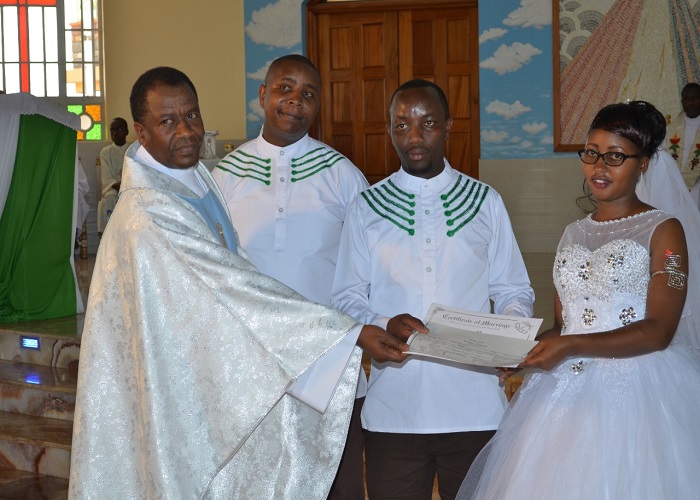
Fr-In-Charge, Holy Family Basilica
Christian religious commitment entails translating of what one believes into practical life situations. This means that a believer is influenced by the Christian religious teachings and values to the extent that his/her thinking, attitude and behavior are strongly linked to the said religious teachings and values.
Marital satisfaction is a critical phenomenon in marriage as it tends to play a pivotal role in the success and fruition of any family institution. In recent times incidents of family violence, separations and divorces are increasing globally. Marriage trend is now shifting towards later marriages and early divorces.
Click the link below to read the full version of the research publication by Fr. Peter Kamomoe
http://www.iajournals.org/articles/iajsse_v1_i5_58_74.pdf
The Catechism of the Catholic Church, Articles 1423-1442 recognize confession as a process in the church where Christians confess sins committed after baptism and have them absolved by God through the administration of a Priest. In the words of Pope Francis, “Confessional is a place where people can find forgiveness and mercy, not threats and condemnation”. It is good to note that official Church publications usually refer to the sacrament as “Penance”, “Reconciliation” or “Penance and Reconciliation”, the laity continues to use the term “Confession” to refer to the Sacrament.
What the Sacrament of Penance offers
For the Catholic Church, this sacrament intends to provide healing for the soul as well as to regain the grace of God, lost by sin. A perfect act of contrition, where penitence expresses sorrow for having offended God and not out of fear of eternal punishment, even outside of confession removes the eternal punishment associated with mortal sin, but a Catholic is obliged to confess his or her mortal sins at the earliest opportunity.
In theological terms, the priest acts in persona Christi (person Christ) and receives from the Church the power of jurisdiction over the penitent. Several theologians have quoted John. 20:22-23 as the primary scriptural proof for the doctrine concerning this sacrament, but Catholics also consider Mathew 9:2-8, 1 Corinthians 11:27, and Mathew 16:17-20 to be among the scriptural bases for the sacrament.
The Catholic Church teaches that sacramental confession requires three “acts” on the part of the penitent: contrition (sorrow of the soul for the sins committed), the disclosure of the sins (the confession), and satisfaction (the penance, that is., doing something to make amends for the sins). The basic form of confession has not changed for centuries, although at one time confessions were made publicly.
Usually, the penitent begins sacramental confession by saying: “Bless me, Father, for I have sinned. It has been [state time period] since my last confession”. The penitent must then confess what he/she believes to be grave and mortal sins, in both kind and number, to be reconciled with God and the Church. The sinner may also confess venial sins; this is especially recommended if the penitent has no mortal sins to confess.
There is an old joke about a carpenter who went to confession after he had been stealing timber from his job site. He confessed, and the priest said, “For your penance, make a novena.” The carpenter replied, “I am not quite sure what a novena is, Father, but if you have the blueprints, I have the timber!”
The story is good for a laugh, but it makes a good point. It raises the question of whether in the Sacrament of Penance anything good can come from our guilt and our sins. Notice the use of the term penance rather than confession. Confession is just one moment in the celebration of the Sacrament of Penance. Confession probably gets the most attention because it is the scariest part no one likes to have his or her sins brought into the light even if it is in the darkness of a confessional.
I agree with these sentiments of Pope Francis that through the sacrament of reconciliation, Jesus Christ does not threaten but rather calls us with kindness, having confidence in us, which allows people seeking forgiveness to take a step forward on the path of conversion. As a confessor I have often reminded the penitents that a confessional is a place where one can go to seek forgiveness humbly; it is not a dry cleaner where one goes to remove the occasional stain but a place we repair our relationship with God and neighbor.
Like the merciful father in the parable of the prodigal son, God is eager to forgive; each time we go to confession, God embraces us. God rejoices (cf. Luke 15:11-32). The Holy Father stresses that forgiveness of our sins is not something that we can give ourselves. In confession, we ask for forgiveness from Jesus.
“Forgiveness is not the fruit of our efforts but rather a gift; it is a gift of the Holy Spirit who fills us with the wellspring of mercy and of grace that flows unceasingly from the open heart of the Crucified and Risen Christ.” (Cf. General Audience February 2014). However, it is not enough to only ask the Lord.
The shame we feel speaking our sins to a priest makes us more humble, as we unburden ourselves before God. When one is in line to go to Confession, one feels all these things, even shame, but then when one finishes confession one leaves free, grand, beautiful, forgiven, candid and happy. This is the beauty of confession.
Personal experience
Since childhood, I have approached the Sacrament of Penance and Reconciliation with some fear and uncertainty. As a young boy I never saw the beauty of confession, hence understanding the struggle that penitents experience when accepting and participating in this sacrament, then one needs to be courageous and go to confess one’s sins. I remember before my first confession, I used to ask myself some questions: “what if my sins were not the same as the other children? What if my sins were far worse and the priest refused to forgive me?”
To receive the First Holy Communion, I knew I had to confess first, so I composed myself and earnestly prepared for it. When I was finally ready,
I went to the confessional box, and others were also waiting. As I looked at the box, all my fears started resurfacing. To make matters worse, I started worrying that the people waiting in the queue might hear what I was saying to the priest. What if they heard all the sins I confessed? What would they think of me?
From a distance, seeing penitents go to confession did not look like a big deal at all, but now that I was faced with it, I realized this was much more of an emotional experience than I had previously understood. I wondered if it would get more comfortable with time. Finally, it was my turn. I entered the confessional box, knelt down, made the sign of the cross, and my mind went completely blank. I could not remember a thing of what I was supposed to do. My fears had come true! I knew I was supposed to say something to the priest before I started stating my sins, but I could not remember what I was supposed to say. I just knelt there in silence, but no matter how long I waited, I could not remember what to say.
Then I remembered that I was talking to Jesus, not a priest. I knew Jesus would understand, so I found the courage to honestly tell the priest that I had forgotten what to say. I hoped he would take pity on me and guide me through the process. I was sure that is what Jesus would have done.
At first, I thought he was going to help me. He asked me what I came to do in the confessional box. I told him that I desired to receive the First Holy Communion with a clean heart, but I could not remember which things to say in the confessional. I begged him to lead me through the confession process and help me make a good confession. Instead, he told me that I was old enough and I did not need guidance.
I knew I was older than most kids when they made their first confession, but I thought he would understand. I was wrong. He never took pity on me. Instead, he took on a very condescending tone and said, “You are old enough, and yet you do not even know how to confess?” I honestly said, “Yes, because it was my first experience, and I had just forgotten how it is done.”
I got confused because he was not willing to help me out and I asked him for permission to come out of the confessional for more preparation; he immediately dismissed me. Though embarrassed and hurt, I could not believe how I was dismissed; I still gathered the courage to prepare and faced him once again.
Luckily, I met a Catechist who was kind enough to remind me of what I was supposed to have done. I returned back to the confessional. This time I would remember everything. I entered the confessional box again and told the priest that I was now well prepared to confess my sins. I was confident he would be pleased to hear I had prepared myself so quickly.
Again, I was wrong! He laughed, and, in the same condescending voice, he said to me, “You think you are prepared now?” I resolved to stay calm. I said, “I think so,” and, after that, I confessed the sins I could remember.
When I finished, he immediately started asking me whether or not a normal person would do such things. He shouted names at me. He said he would not absolve me from my sins and that I should go and look for another priest to confess. I could not believe it! My worst fears had come true. I came out of that box downcast. I felt rejected, discouraged, and torn apart.
As I went out of the box, I realized that everyone waiting in the queue to make their confession had heard the priest yelling at me. Was this all a bad dream? It could not be happening to me, could it? Everyone waiting there was laughing, and I felt humiliated. I was sure they were all laughing at me, making me a laughing stock? What was I to do now? I went straight to the only one who I knew would truly understand and knelt in front of the Blessed Sacrament and narrated to Him my dark experience.
I prayed for a very long time. At first, I was filled with pain and humiliation. I wept for all the pain that was inside me, but the more I prayed, the better I began to feel. I knew in my heart that what I had experienced with that priest was not something that Jesus wanted any human being to experience.
He did not come to this earth to humiliate us for our sins. He came to bring us hope and love. He died for our sins that we might live. At some point during that prayer, my childhood ambition to become a teacher faded away. I realized that, even though that priest had tried to humiliate me, what he did, changed my life. He could bring me down, but he could not keep me there.
It was through his humiliation that I genuinely understood Jesus’ love. At some point during that prayer, I resolved to become a priest. I understood what it meant to be a sinner, and how it felt to be humiliated, rejected, and to be told my sins would not be forgiven. I knew I may be a compassionate priest who would lead people to Jesus.
I made a firm resolution to become a priest which was such a difficult decision for me because I knew not everyone in my family would accept this decision. I thank God today I am a priest, dedicating most of my time to listen to confessions because I would not want penitents to go through the experience I went through. As a confessor, my role is to help penitents to leave the confessional with happiness in their hearts.
Therefore, I urge you to focus on the Sacrament of Reconciliation as an important dimension of experiencing God’s mercy. Through this experience we will be rediscovering a path taking us back to the Lord, living a moment of intense prayer and finding meaning in our lives. Let us place the Sacrament of Reconciliation at the center of our spiritual journey where we can touch the grandeur of God’s mercy with their own hands.
Consequently, the Sacrament of Reconciliation is a profound gift that strengthens our relationship with Christ, heals us, and renews our baptism when we were first incorporated into the community of faith.
The writer is an Assistant Priest at, HFMB
Liturgy is public worship which the Catholic Church makes every effort to incorporate and involve our senses and our entire being into
our act of worship.
In this article, I invite us to think about the importance and significance of some postures and gestures in the celebration of the Holy Eucharist. We are all very aware of our Catholic calisthenics which are a routine part of the Liturgy, namely sitting, standing, bowing, kneeling and silence at various times.
These postures serve an important purpose and reveal the importance of the action taking place. When we enter the church and make the sign of the cross; let it be a real sign of the cross. Instead of a small overcrowded gesture that gives no notion of its meaning, let us make a large unhurried sign, from forehead to breast, from shoulder to shoulder, consciously feeling how it includes the whole of us, our thoughts, our attitudes, our body and soul, every part of us at once, how it consecrates and sanctifies us. Upon entering and leaving the church, we face the Tabernacle where Jesus is reposed and genuflect.
A genuflection, made by bending the right knee to the ground, is a sign of adoration. It is therefore reserved for the Most Blessed Sacrament. This act requires that it be performed in a recollected way. In order that the heart may bow before God in profound reverence, the genuflection must be neither hurried nor careless. Our faith, devotion, and reverence at Mass is further manifested through the various gestures and postures (standing, kneeling, sitting, bowing) prescribed by the church, as we express in a unified exterior manner what the interior disposition holds so dearly. These gestures and postures have profound meaning and when done with understanding, can enhance our personal participation at Mass. Sitting may be seen as our “learning” mode. We think of the various times at which we sit during the Sacred Liturgy, in particular, the Scripture readings from the Old and New Testaments as well as during the homily.
Standing may be seen as our “preparing” mode: We stand at various times during the Liturgy, most importantly when we are preparing to receive the Lord in His Word through the proclamation of the
Gospel and receiving His Body and Blood in Holy Communion. Kneeling is an expression of our humble submission before the majesty of God, penance and a spirit of repentance, adoration and reverence in prayer. We kneel, when we reach our pews for personal prayer. We also kneel during part of the Eucharistic Prayer.
Folding our hands; our hands, like every part of the body, is an expressive instrument of the soul. When we enter into ourselves and the soul is alone with God, our hands closely interlock, finger clasped in the finger, in a gesture of compression and control. The Ceremonial of Bishops (Caeremoniale piscoporum), published in 1985, prescribes the manner of folding hands: “palms extended and joined together in front of the breast, with the right thumb over the left in the form of a cross”. This action reflects a sign of intimate and personal prayer to God.
Silence has its place and importance as a help toward the promotion of the required interior disposition to prayer. “At the proper times, all should observe a reverent silence”, the constitution of the sacred liturgy (Sacrosanctum Concilium, 30). A period of silence before Mass begins is help to recollection. After the readings and the homily, a suitable period of silence can help us to meditate and interiorize what we have heard. We should refrain from chatting away… or SMSing on the phone. Silence helps us to bask in the indescribable glory of the Blessed Sacrament.
We can often compare our sacred actions with similar secular actions. For example, those serving in the military saluting an officer of higher rank;
removing one’s hat and holding a hand over his or her heart when the flag of our nation passes by or the National Anthem is sung; raising one’s right hand when taking an oath; standing up to show courtesy and respect for others. Just as these actions and gestures have important significance and meaning to us, so too do the actions, postures, and gestures that the Church incorporates into her worship of God. In celebrating the Sacred Liturgy, we know that some actions or gestures are intended for all those present, while other actions or gestures are reserved to the principal celebrant, concelebrating priests, or deacons. The distinction of these gestures reflect the role of each person participating in the action of the Liturgy.
Some of the common gestures for the assembly, the principal celebrant and concelebrants, and other liturgical ministers are the genuflection, blessing one’s self with the Sign of the Cross at various times; making the Sign of the Cross on one’s forehead, lips, and breast at the introduction of the Gospel; and bowing the head at different times during the Liturgy, in particular during the words commemorating the Incarnation when the Profession of Faith is offered. There is also the lesser known tradition of bowing one’s head out of respect when the three Divine Persons. Those who share in the Sacrament of Holy Orders reverence the altar with a kiss
A gesture reserved to the principal celebrant is the extension of the hands during the various greetings.
As a sign of unity within the priesthood, the principal celebrant and concelebrating priests extend their hands together at different times during the Eucharistic Prayer, during the offering of the Lord’s Prayer, or for a blessing.
NOTE: THERE IS NO PLACE OF EXTENDING HANDS DURING MASS FOR THE LAY PEOPLE.
These are just a few examples of the many important actions and gestures which are part of the Liturgy. Our worship as Catholics is very “rich” with signs, symbols, and gestures, many of which have ancient origins. The next time you attend Mass, Make these actions and gestures part of your own personal participation in the Liturgy and offer them with care, devotion, and sincerity. They are not just simple and empty actions but reveal to us the great Mystery of God.
By: Rev. Fr. David Mbugua Kinyanjui
The writer is the priest in charge of Liturgy
Holy Family Basilica

At the general audience, the Pope speaks of the need for a true catechumenate, for “we play all our lives with love yet love can’t be played with” “We cannot talk of “preparation for marriage” with three or four parish classes”. The Pope said so at the general audience in Saint Peter’s Square: what is needed is true catechumenate, for “we play all our lives with love yet love can’t be played with”.“The call to married life thus requires a careful discernment of the quality of the relationship and a time of engagement to verify it. To enter the sacrament of marriage, engaged couples must mature the certainty that in their bond there is the hand of God, which precedes and accompanies them, and will allow them to say: “With the grace of Christ I promise to be faithful to you always”, the Argentine Pontiff said.
“They cannot promise fidelity “in joy and pain, in health and in sickness”, and to love and honour each other every day of their lives, only on the basis of goodwill or of the hope that “things will work out”. They need to be based on the solid ground of God’s faithful Love. “The Sixth Commandment can safeguard us from so many forms of adultery”. And for this – Jorge Mario Bergoglio added – before receiving the sacrament of marriage we need careful preparation, I would say a catechumenate, for we play all our lives with love yet love can’t be played with. One cannot talk of “preparation for marriage” with three or four sessions given in the parish: no, this is not preparation, this is false preparation, and it’s their responsibility, of those who do this, on the parish priest, on the bishop who allows these things. The preparation must be mature and take time, it is not a formal act, it is a sacrament: but it must be prepared with a true catechumenate”.
Today the Pope spoke of the sixth commandment, “You shall not commit adultery”, in the framework of a cycle of catechesis on the decalogue entrusted by God to his people. “No human relationship is authentic without fidelity and loyalty”, he said, “one cannot love only as long as “it is convenient”, love manifests itself just beyond the threshold of one’s own advantage, when one gives everything unreservedly” and “even a friend proves authentic because they remain so in all circumstances, otherwise he or she is not a friend”.
The human being, the Pope said again, “needs to be loved unconditionally, and those who do not receive this welcome carry within themselves a certain incompleteness, often without knowing it. The human heart tries to fill this void with surrogates, accepting compromises and mediocrity that have only a vague taste of love. The risk is to call “love” relationships that are unripe and immature, with the illusion of finding the light of life in something that, at best, is only a reflection of it. This leads to overestimating physical attraction, which in itself is a gift from God but is aimed at preparing the way for an authentic and faithful relationship with the person”
Francis said, who quoted in this regard St. John Paul II, who in a catechesis of 1980 said, the human being “is called to the full and mature spontaneity of relationships”, which “is the gradual fruit of the discernment of the impulses of one’s heart”. It is something that is conquered since every human being “must with perseverance and consistency learn what the meaning of the body is”
Fidelity, the Pope said, “is a way of being, a way of life: to work with loyalty, to speak sincerely, to remain faithful to the truth in one’s thoughts, in one’s actions. A life interwoven with fidelity is expressed in all its dimensions and leads to being faithful and reliable men and women in every circumstance. Yet our human nature is not enough to reach such a beautiful life; it is necessary that God’s fidelity enters into our existence”, the Pope concluded, underlining that “From communion with Him, with the Father and with the Holy Spirit comes the communion between us and the ability to live our bonds in fidelity”.
Excerpt from the Basilican Magazine 8th Edition, 2018